Trip! Or, Repetition Makes Us Happy

Life can only be understood backwards; but it must be lived forwards. — Søren KierkegaardSo, it's Sunday, and we're home a week from Scandinavia, and Jenifer and I decide to see a movie. I figure by this time I have the whole driving-a-car-again-after-not-driving-a-car-for-23-days routine down, and so with utter confidence, nay, abandon, I pull into the lot of the local Regal Marketplace and park. We get out and proceed in the direction of the multiplex. One small detail, however, suddenly captures our attention. The car is still running. That's odd, I think, my keys are not . . . in . . . my . . . pocket!
I mention this not to draw untoward criticism of my driving abilities or general wherewithal, but to provide a moviegoing tip for the cost-conscious screenwriter. See, the manager, after contacting the licensed professional dour-faced police officer who eventually unlocked the locked door, gave us two tickets to the movie of our choice, so that we might "let go of our stress." I can't promise this strategy will work every time, but you never know. Lady in the Water, by the way, is a fine film.
But you're not interested in finances and stress reduction, you say. That's alright, since the plan all along was to recap the last two days in Copenhagen and then provide an analysis of What It All Means. Before we get started, however, I should point out that a smattering of photographs from the trip (to Sweden, Finland, and Denmark, for those just joining us) now accompany the text (thanks to Mozilla Firefox and not that other big-name browswer).
 Friday, then, began with another helping of the Best Brunch Ever, served up at Cafe Europa. Jenifer and I had discovered this place towards the end of our last trip to Copenhagen, and it was one of the chief experiences we were determined to repeat. On our first stroll down Strøget this time, we both sighed in relief as we saw that Europa ("Since 1989") still occupied the same corner.
It's been suggested that I have a touch of OCD, so I endeavor where possible to try new things, to avoid the safe, familiar, comfortable patterns. This is most easily and fruitfully done when traveling. Sometimes, though, it's best to stick with what works, and that's where the concept of Repetition Makes Us Happy, as Jenifer likes to tease, really shines.
We followed up our repast with a trip to the Danish Museum of Art and Design, completing our Nordic design hat trick. The 20th century exhibits were the most exciting, and it was illuminating to see everyday objects -- chairs, lamps, posters -- embodying the concepts I'd studied in graduate school. Here the accompanying words of Adorno and Baudrillard and Lyotard came to life, here one saw how the design, production, and consumption of material culture informed a nation's identity. From "Ecology, recycling, and sustainable design":
Environmental design . . . incorporates embryonic concepts for new patterns of consumption, e.g. right of use instead of right of ownership, joint rather than individual ownership, and focus on opportunities for upgrading or repairing existing objects instead of buying new ones.The Danes put this into practice. Perhaps one of the most visible ways is Copenhagen's City Bike program, wherein you unlock a public bicycle by depositing a 20-kroner coin, and then ride, rack the bike, and collect your deposit. (Incidentally, the white-and-green building in the background of the picture on the City Bike's home page is to my direct right in the "brunch" shot above.) I only wish the Danes would innovate a similar City Toilet program.
The museum also houses plenty of other artifacts, some illustrating the history of the famous Danish Design (originally inspired by English woodworking), others more regional pieces. Jenifer was particularly moved by the textiles, which illustrated the history of two highly regarded female designers and the studio they shared as master and apprentice.
Afterwards, we chanced upon more trail magic in the form of a two-hour conversation with a nearby shopkeeper, leaving just in time to cross town and catch our assigned seats for the further adventures of Will and Elizabeth. We found it thoroughly entertaining, as good or even better than the first one, though I missed a few lines of dialogue while trying to read the Danish subtitles.
Saturday saw us breakfasting once more at Europa -- our fourth such outing that week -- and then shopping a bit and spending our final Copenhagen hours at Tivoli Gardens, one of the world's oldest amusement parks (second only to one in nearby Klampenborg). Then back to our home in Islands Brygge and the reality of an early-morning flight.
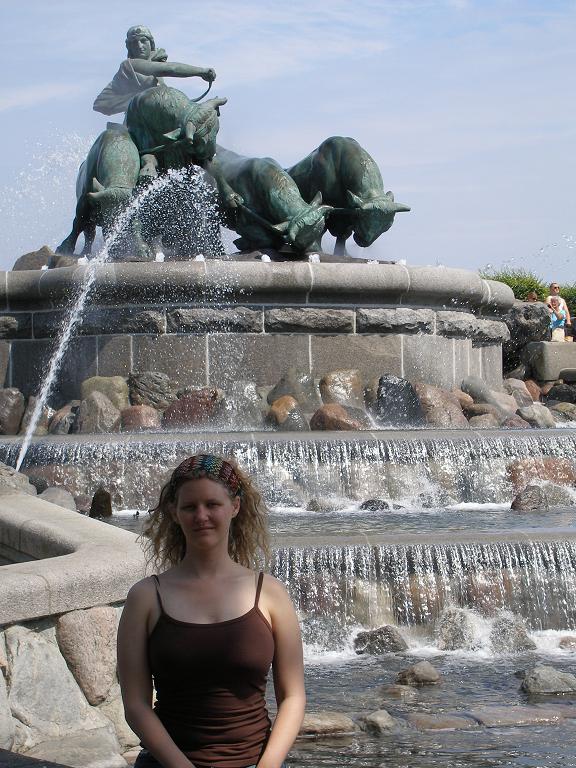 It's strange to be in a place that feels so familiar. If I have a spiritual home, it's Copenhagen. And yet Jenifer and I both felt something of a letdown this time, a feeling we were loathe to acknowledge. Repetition wasn't Making Us as Happy as we expected. We realized after a few days that the city hadn't changed dramatically (apart from the swarm of high-season tourists), but that our expectations of repeating our honeymoon were unrealistic. This time the magic, the newness, was to be found in Sweden and Finland, which were previously unknown to us. And so returning to Denmark was like returning to an old friend rather than meeting a new lover. Not as wondrous an experience, but deeper.
Speaking of old friends, I was asked whether, in terms of the script research, I had found what I was looking for. I had conceived the trip, in part, as a research venture that would enhance my knowledge of Norse history and culture — what I needed to write my historical epic. In some ways I had found what I was looking for, discovering a wealth of material I hadn’t conjured from the pile of books I’d read. In a number of cases, however, plans that seemed sure bets on paper did not come to pass. So I decided to seek a middle way, a balance between structure and spontaneity: an idea of what I wanted coupled with a willingness to receive what the universe was willing to offer. More and more, I saw that sometimes my expectations were either unrealistic or too stringent, and the things that happened did so easily, without struggle. Sometimes letting go is the best way forward. Sometimes, Fun is Simple.
Labels: Cafe Europa, Copenhagen, Denmark, design, Scandinavia
posted by Ryan Rasmussen at 8:58 PM
1 comments


